Septeo launches AI channel manager, Gstaad Palace opts for dailypoint, and Estival boosts direct sales
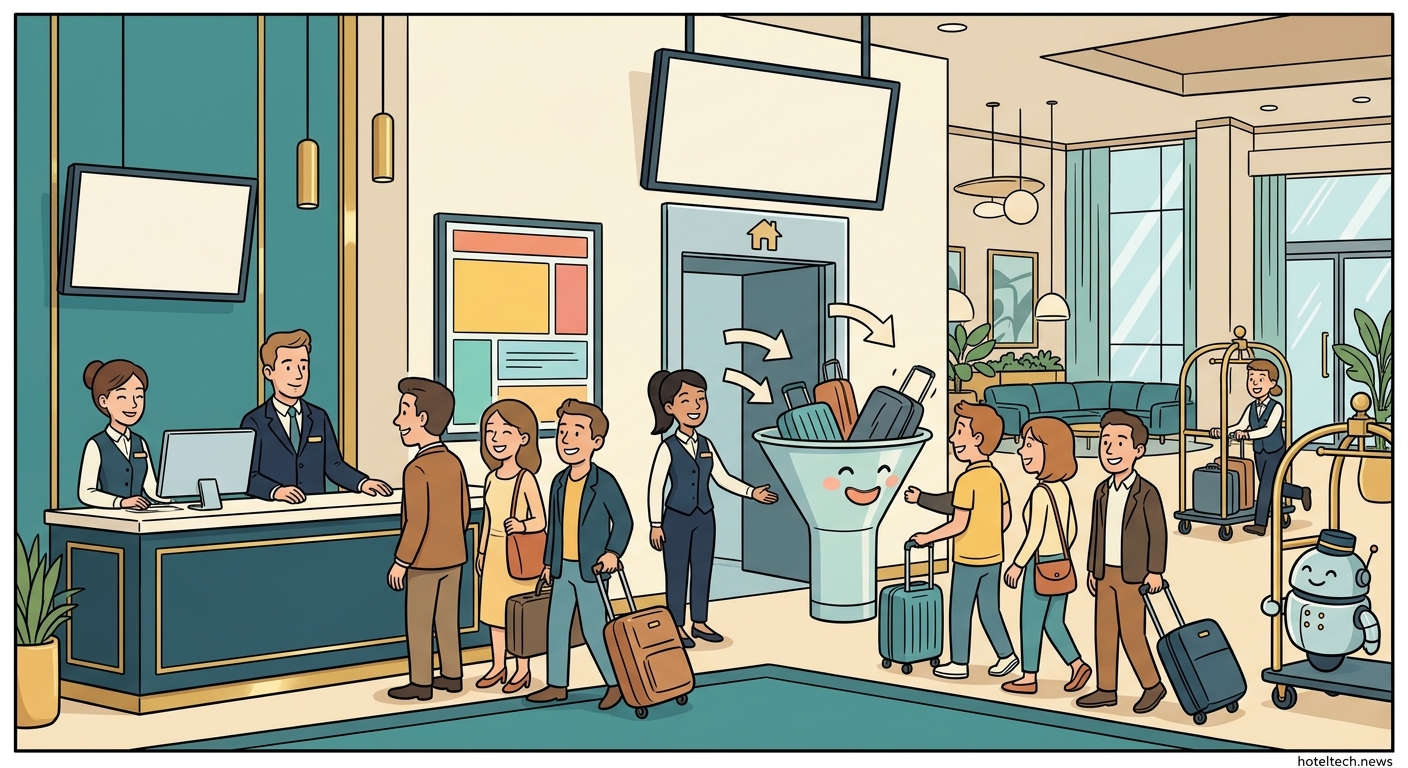
Hotel technology is consolidating around three pillars today: AI-driven distribution, unified guest data, and the measurable payback of direct sales. The news reflects a sector that has stopped buying tools and started building ecosystems, where every investment must be justified by data.
Septeo Hospitality has launched a new channel manager with integrated AI, while the iconic Gstaad Palace has chosen dailypoint to unify its guest data. At the same time, a new report shows that direct booking guests return at 4x the rate of OTA guests, and Estival has ramped up its conversion with Paraty Tech. We are watching a transition from isolated solutions to connected platforms.
Today's brief
Septeo Hospitality consolidates Ulyses Suite with an AI-powered channel manager. The French vendor is positioning itself as a full ecosystem for hospitality, where distribution, PMS and guest tools work together. The new channel manager includes AI applied to distribution processes, which allows hotels to optimize rates and availability without manual intervention.
- The solution aims to simplify distribution and strengthen the integration between the tools of the Ulyses Suite ecosystem.
- The AI component applies to distribution, automating tasks that traditionally required constant monitoring.
- For the hotelier, the value is the promise of fewer operational touches and more time to focus on strategy, as reported by Smart Travel News.
Gstaad Palace bets on dailypoint to unify guest profiles. The 5-star Swiss property, open since 1913, will use dailypoint to consolidate guest data from systems including protel, TAC and aleno. The goal is a single central guest profile that can be used for CRM and personalized service. This is a clear example of how even iconic luxury hotels are prioritizing data infrastructure.
Hotel tech
The investment in hotel technology is moving from annual budgeting to multi-year planning. Hospitality strategist Mark Fancourt argues in Hospitality Net that hotels should replace annual tech budgets with a multi-year approach, using guest and staff feedback diagnostically to identify capability gaps before selecting solutions. This means that the purchase decision starts with the operational problem, not with the vendor's pitch.
Digital tipping is becoming another piece of the property's core stack. More hotels are moving away from cash tips and adopting software that allows guests to tip digitally via cards or mobile wallets. The trend is driven by changing guest habits and the need to simplify operations and reward employees efficiently, as discussed in Hotel Technology News.
For hoteliers, this has two direct implications. On one hand, it improves the employee experience, which is key to retention in a labor market that is hard to manage. On the other, it integrates guest data and payments into a single system, reducing internal friction.
Multi-site maintenance software is also gaining ground in hotel groups. Managing a portfolio of properties with different procedures and inconsistent metrics creates pressure on budgets and equipment. Standardizing maintenance through software is becoming a priority for brands that want to ensure consistent quality across all their properties, according to Hotel Technology News. And that consistency directly impacts guest experience and operational costs.
Revenue and distribution
Direct booking guests return at 4x the rate of OTA guests, and the data changes the ROI equation. A guest who books direct has a 5.1% return rate, while an OTA guest returns at just 1.3%, according to data analyzed by eHotelier Insights. More importantly, the gap holds across the same hotels, meaning it is not a property effect but a booking channel effect.
| Channel | Return rate |
|---|---|
| Direct booking | 5.1% |
| OTA | 1.3% |
This data gives Revenue Managers a powerful argument to invest in direct sales tools. The cost of acquisition for a direct booking is not just lower commission, it is also a customer who will come back.
Estival is already riding that wave. The Spanish chain, present in Costa Dorada, Costa del Sol and Andorra, has turned to Paraty Tech to reinforce its digital acquisition ecosystem. The strategy revolves around three channels: Google Ads, metasearch and Social Ads. The goal is to diversify demand and gain volume without losing efficiency, according to Hosteltur.
What stands out is that Estival has integrated the entire digital marketing management into a single partner. That gives them speed and consistency in the message, but it also raises the challenge of ensuring that media spending on Google and metasearch does not cannibalize each other.
AI in hospitality
AI is moving into channel management and distribution. Septeo's new channel manager includes AI applied to distribution processes, which could be a first step toward automated pricing and availability strategies. The key, however, is that AI is not being sold as a separate module but as a layer integrated into daily operations.
Hospitality schools are also preparing the workforce for this change. Lecturers at Hotelschool The Hague argue that students need VR simulations, AI prototyping and Makerspace environments to be digitally work-ready, according to Hotelschool The Hague. If the industry is adopting AI, the next generation of managers must arrive with hands-on experience.
The obligation to insure against data breaches grows as the industry digitizes faster. One injury, one fire or one data breach can generate costs above any cash reserve, which makes business insurance a fundamental part of the hospitality technology stack, as warned by Revfine. The more technology, the more digital risks to cover.
What we are watching
- The evolution of Ulyses Suite: Will Septeo integrate its AI channel manager with an RMS or dynamic pricing module in the next quarter?
- The ROI data on direct sales: If return rates of direct customers are confirmed at 4x OTA, hotel chains will accelerate their investment in metasearch and loyalty tools.
- The Gstaad Palace project: The implementation of dailypoint in a hotel with multiple systems is a benchmark for the luxury segment, leadership changes at Cushman & Wakefield: Fred Le Fichoux's progression with more than 20 years at the firm is the consolidation of the EMEA hospitality platform, after Jon Hubbard's retirement, as reported by Hospitality Net.
- In just a few weeks, from September 22 to 24, the Skift Global Forum 2026 will start.
Investing in technology is about building a foundation for the next five years, not solving a problem for the next season. Those who design their stack with multi-year vision and data will be the ones with a competitive advantage. The rest will keep patching up the day to day.
Companies
The hotel tech and travel tech companies we follow, plus the ones surfacing in today's news.
- In today's news
- Septeo HospitalityVendor francés de software hotelero que consolida su Ulyses Suite con un nuevo channel manager con IA para simplificar la distribución integrada.
- Paraty TechCompañía española de tecnología hotelera que impulsa la venta directa de Estival con una estrategia de marketing digital multicanal.
- dailypointPlataforma de gestión de datos de huéspedes elegida por Gstaad Palace para unificar su CRM y centralizar perfiles de cliente.
- Cushman & WakefieldLa consultora inmobiliaria nombra a Fred Le Fichoux como nuevo líder de Hospitality para EMEA tras la jubilación de Jon Hubbard.
Was this article useful?
The daily brief
The hotel tech brief, in your inbox
PMS, revenue, distribution, AI and travel tech startups. One sharp email a day. Free.
The brief hoteliers who buy technology read every morning.
Editorial content by Hotel Tech News. It may contain errors. Verify anything important with the original source.
This article may mention third-party products, companies or services for informational purposes. Hotel Tech News does not endorse them and is not responsible for them or for what they offer. Editorial content curated by the Hotel Tech News team.